I went a little off-script recording. So here’s a transcript!
All recordings are now up at https://soundcloud.com/sde_dispatches/sets/self-directed-education-and-the-agile-learning-approach-an-introduction
Hey, welcome to Holding Unfolding, a podcast exploring facilitation that for the past seven episodes has been exploring chapters of an e-book that I put together on some of the, like, context and history and ideas that are under the design of Agile Learning Centers generally and the, the New York Agile Learning Center where I’m based specifically.
So, in this episode, we’re going to read through the end of that text. And, frankly, it’s very short and mostly a bunch of recommendations and references. Then I’m going to share some reflections on what I learned from putting this together, putting this document together, and some of the possible future projects that I see a need for, and would be excited to either have someone else pick up and create and offer to the network… or to find a way to do myself. We shall see.
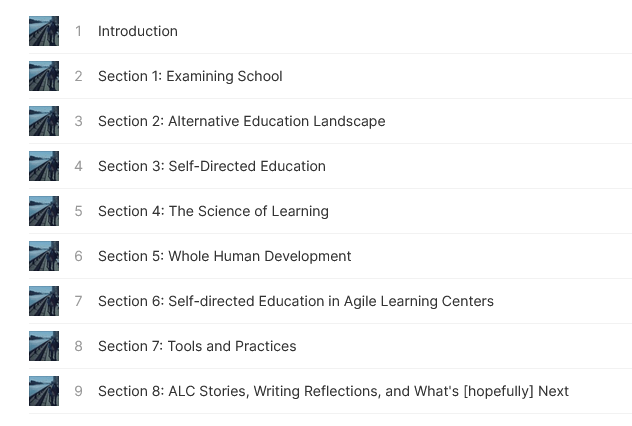
So. First, the end of the e-book, the Intro to Agile Learning Centers (“Self-Directed Education and the Agile Learning Approach”). There’s two final sections. So the first one is “Stories from ALCs Around the World.”
“Facilitators refer to self directed education as a practice. As we learn, experiment, reflect, and iterate, we often talk and share helping each other grow and deepening the relationships that make us a learning community across as well as within our centers.
We don’t always write or record these conversations, but sometimes we do. And so some of them are available for you too.
There’s a panel of ALC-NYC students and facilitators sharing about their experiences at vimeo.com/562606383. There’s a video of a panel of Educambiondo ALC students and facilitators sharing about their experiences at vimeo.com/562614782.
You can check out Crystal Byrd Farmer’s piece “They Played Their Hand, and We Have to Say, ‘We’re Not Going Back” at self-directed.org/tp/we-are-not-going-back/ along with Jeana Jones’ “Everyday Conversations” at self-directed.org/tp/everyday-conversations/.
The mini documentary “Live and Let Learn: A Day at ZigZag ALC” is online at youtube.com/watch?v=eSPX3spdBUU.” I don’t know y’all. The original version of this e-book was an online course, and so these were all hyperlinks that I just copied over. And if the state of web search were different, maybe I would give people keywords (instead of long number-letter-soup urls) to search to find these resources and pictures so they would know when they found the right one. But… this is a draft. We’ll see if it works.
The other resource shout-outs in this section are Mel Compo, who doesn’t facilitate at ALCs anymore, but wrote a cool article a while ago. That’s up at self-directed.org/tp/alf-weekly-routine/. And then another shout out of Akilah Richards and her YouTube videos and TED talks and podcasts. And then the 2020 Annual Report from the ALC network, which —
I put together an annual report for the ALC network every year, and they’re all online on the network website, agilelearningcenters.org. But specifically the 2020 annual report, like, because people had been so online, they both had more content to, offer… There was less happening that was like ephemeral in the real life space. You know, in, in normal facilitation practice and ALC-land, there’s a lot of things kind of just happening day-to-day in the moment. And to stop and document and turn, you know, a reflection on that experience into an artifact that the network could share would require a lot of time and effort.
Um, so in 2020 people had a lot of screenshots and recordings and resources from their online and outdoor offerings. And people were just at their computers more, and hungery for social connection and to be witnessed. And so the 2020 annual report for the network has a lot of content and is really vibrant.
So like, you know, I’m biased. I would say they’re all worth checking out. It’s cool to see how things grow and change over time. And-but if you were to pick just one to look at, the 2020 report is the one to look at.
And that section of the e-book closes with, “There’s more, but if you really feel curious, reach out to an ALC, or self directed learning center, and see if you can visit for a day, or attend their next open house.”
And, I’m gonna add a caveat, to the audio and this text, that’s just if you are asking to attend for a day — not that this is really a concern for anyone who’s made it to this point in the e-book or my podcast, but you know — you want to move into spaces where you’re a guest and where people have primary responsibilities to their teammates and the young people they’re working with and each other. So you want to move mindfully and with the awareness that you’re a guest. And ideally with some offer of reciprocity. Maybe it’s a donation to the space. Maybe it’s that you’ve brought a game or an offering, for if they’re interested. You know, you don’t want to always assume that everyone should be, exists to be your audience, right? Like they’ve got their own projects and interests. But it’s nice to offer. And often like very much appreciated and people can be excited about it, if the stars and your interests align! Or even just an email to the facilitators afterwards with a thank you and some things that were your takeaways, what did you learn or what was striking to you… That can be really kind of validating and supportive for a facilitation team. And it helps them — It’s extra work to host people, especially on top of running the day-to-day. So if you’ve got a way to show that you acknowledge and appreciate that and that it was impactful, you should do that. It’s worth doing, and it helps the hosting facilitator team and the young people — if you want to shout out the young people — it helps them feel like their efforts were worthwhile and like they want to do it again.
And then the last section of the e-book just says “Where to go from here?”
“Congratulations! You’ve completed this introduction to self-directed education and Agile Learning Centers. Time to review, reflect, celebrate, and rest. And then there’s always more to learn.
“There are hours of content included and referenced in this text, but if you want more or are looking for a community of practice to start applying your learning with, you have options to do that, too.
“You can connect with your local ALC about visiting, volunteering, or participating in any reading groups they have going on. You can attend a training or workshop hosted by self-directed folks near you. You can head over to starterkit.agilearningcenters.org (UPDATE: actually https://agilelearningcenters.gitbook.io/agile-learning-centers-starter-kit-v3-0) to download the free multimedia bilingual starter kit, or become a network member to access internal newsletters, calls, and Slack conversations.
“Best of luck wherever your learning adventures bring you next! And remember to stay curious.”
And then, there’s just my biography. Because that’s an obligatory thing to put in a book, according to my online publishing website. So, that’s it! You did it! And I did it, and thank you for accompanying me in that process.
It was really helpful to read things aloud. It let me make lots of edits to improve kind of the flow and coherence of different sections. In the process of putting this together, this document, like… I wanted to do it because The Starter Kit focuses on the details of how and why to start a center, kind of as, as an organization. And the info sessions and other events we have at our centers tend to focus on the kind of topics and concerns that are really alive for parents and families. So it’s like, How is my kid gonna learn math? Is it okay if they’re playing Minecraft? That kind of stuff. Can they get into college? These are all important avenues of exploration and really relevant things. And for me, and I’m sure for other people, part of what’s interesting about Agile Learning Centers and Agile Learning, is related to the histories of schooling and of alternative schools and of our understandings of how learning works and our understandings of what human beings need to grow and develop into resilient, adaptable, fulfilled beings.
There’s other facets that I didn’t even include in the e-book. The mindfulness practice that is facilitation, or the role of emergence. Theories around chaos and group coherence and inspiring belonging. And patterns and rhythms for organizing and making decisions together. Like… there’s all of these really interesting, rich threads that are enacted in Agile Learning Centers. And not everyone is interested in all the things, for sure. And not all the things are relevant to everyone. Totally cool. Pluralism. Love it.
Um. But I’m, you know, uh, a systems nerd and really fascinated by people.
And so I wanted a resource that was, that I could point to that addressed at least some of these other kind of avenues for why do we do what we do, how we do it, instead of the things that are presently the cultural defaults. And then in writing it, it was kind of tricky for me to figure out — This is a very light version of this text. Each chapter could be significantly longer if it really went into depth and gave analyses and gave examples and if I told stories from what I’ve witnessed and experienced in ALCs and other kind of collective learning contexts. And I was excited to do all that, but then I got a piece of feedback that often in people’s first pass at a book, they try to do everything at once and that that’s actually not helpful. So I was like, all right, let me make it way lighter, actually an intro. And I don’t know if it’s too light to be useful or if it’s just right. I might go back and make the fuller text and then just be like, well both these things are available, pick whichever you want. But it was an interesting challenge to figure out what content is essential for an introduction.
What depth is essential for an introduction in this world where people are flipping through their YouTube shorts and working three jobs and doing whatever 8 million other things people are doing? Which kind of facets should I focus on?
There’s no content, there’s almost no content in here about the self-work of facilitating over time. I tell new facilitators, as I was once told, you know, really give yourself three years to find your feet, and make sure you have other people to be talking to and processing with through that time. Because all your stuff is going to get brought up. And if you’re trying to do this work well, you’re really going to have to assess a lot of your assumptions and your patterns and that’s, I mean, that’s ongoing work. But really the first three years, once you start pulling the thread, like any kind of self work, it’s disorienting. It can be really beautiful, and it can be really gnarly. And people want to “get it” instantly, you know? We don’t always have a lot of patience or compassion for ourselves, and we don’t always feel like we have time to have patience and compassion for ourselves. But the reality is if we rush we’re not going to do good work and we’re going to make a mess. And ourselves and other people will pay the price. So we need teams and collaborations and communities where we can witness and accompany each other and work together and be explicit that these are learning spaces. That’s its own whole other book.
And then, there’s very little content in here about making decisions as a team and picking your governance structures. And like, there’s a little in The Starter Kit, but there’s some people doing really interesting work in the wider world of co-housing and structures for that, or of collectives and open-space events. I’m always looking at what Enspiral’s doing. I think they’re fascinating, and I’m grateful they’re so transparent about their processes.
Really how do you help people step into and out of different roles? And recognize different roles? And learn to give feedback, and learn to receive feedback? And learn to depersonalize– and not just depersonalize but — depersonalize conflict, and also like, not treat it as the exceptional crisis that can and must be avoided. Right? Like… that’s not real. If you’re doing relational work, conflict is going to happen. Over and over again. It’s just part of it. So in the same way with kids, it’s like, if you save them from every moment of discomfort or struggle they don’t learn how to get through those moments and that they’re capable, right? Similarly, as a community, if we are constantly trying to prevent conflict, we’re going to destroy ourselves. Because we’re not going to learn what we’re capable of, and how to increase what we’re capable of, and how to move through those times fruitfully.
So there’s all these system, organizational orientation kind-of-things that I would be really excited to see more of our resources exploring.
Well that was a whole tangent. Thanks for listening to me ramble.
The other things that I learned in writing this, are less about writing and process and more about like the other conversations and themes that I’m excited to see addressed somewhere. Or that I’m excited to address, if I can find time and funding. I’m sure people are talking about these things, but I haven’t seen the resources being shared at a network scale.
I made a list of the things I would be really excited to see. I want pieces about:
Building belonging. And ALCs and their social function in the context of the loneliness epidemic and documented rising rates of anxiety. People say that’s among young people and that’s where the research is, but I’m pretty sure it’s also among older people. Given that context, it seems like our spaces could have a key social role. So, that would be an interesting, cool thing to explore. And how it does and doesn’t connect to what our mission was back in 2013.
I want a piece about relationship to conflict.
I would like some kind of resources about tech. And not like, “What are the coolest new tech tools we can build for self-directed learners to make their portfolios and document to make transcript-creation easier?” There’s a lot of people working on that puzzle. And on, like, matchmaking apps for families and resources. So great. Love that people are doing that. But the questions I’m excited to play with are like, “How do we — facilitators, parents and caretakers, and kids — navigate together this world where it’s become normalized to track each other’s locations and submit pictures of our faces to, do identity verification at the airport or the library or…?” I mean, they took the library ones down, I believe, but there was a moment during COVID where New York had face scanning – temperature scanning things. I want to be asking, “How do we navigate this surveillance tech and this moment where young people — and older people — want to be influencers and so want their faces on the internet, but… how and where and what does that mean?” What do say when my teenagers want to post their art, but they don’t want it to be used to like train algorithms they’re not going to profit from or to generate deepfakes that could harm them or their reputations decades in the future?
There’s a very active conversation of, like, “Screens or no screens?” And “Video games or no video games? Are video games good or video games bad?” But I’m excited and I think it’s urgent and necessary for us to be having all these other conversations. How does chatGPT work? Why might someone’s roommate not be excited about them having an Alexa? All this stuff. And how does that relate to self-directed spaces? Right? How do we navigate it, and how do we navigate it at different scales?
This question of scale is really interesting. That came up in some of my trainings over the summer, where it’s like, there is a certain number of kids or size space where it’s some kinds of tech become necessary to track processes and some become too risky because it would take all the adult’s energy to manage their use. So like, what is that? What does that look like in different spaces? What are the options? How can people kind of discern with their communities, what do they need to be aligned with their values and responsible to and for each other? And clear about what is beyond their capacity? That’s such a question always for folks. It’s hard sometimes, especially in these values-driven kind of heart-based spaces to be like, “I do see that this is the need and I believe it should be done and it is beyond my capacity. And I’m going to be honest about that.” That’s really hard for people sometimes, but it’s really important that we learn how to do that, that discernment and communication.
Okay. Just a couple more. So, the other resources I want to see, based on writing all this and now feedback at summer sessions…
It seems like there has been some fallout where folks who ran and stewarded centers and communities through kind of the acute parts of 2020 — Some places there wasn’t a lot of upheaval, but like, in New York city, it was pretty intense. And I’m hearing from people who stewarded their communities through, 2020 to 2023, 24 — there’s been fallout. People are reassessing their values. People are not capable of what they once were. Folks’ relationships changed and in ways that have led to needing to reorganize their centers. And there’s a bunch of folks who are just burned out, whether that’s the chronic stress or overwork or some kind of disillusionment, disappointment. So I’m curious to talk through that with folks experiencing that arc. Like, what are folks doing? What do folks need? What can we learn?
There’s a piece that would be awesome about how agile in the world, in our learning centers and beyond, has changed. How has it changed in practice and how have people’s understandings of and reactions to it changed? And what have we learned? It’s now been over 10 years of the New York School and 10 years of the network. So I’m excited for a lot of “what have we learned” pieces.
I would also love to see one that is about the network itself. Like maybe interviews with a bunch of the people, the oldest folks in it. Or the folks who were in it at the beginning and moved on. Like, let’s circle back and see… I know I’m still in touch with some of them and they’re doing cool things. So like, where are folks and what are they up to and what have we learned? It would also be cool to interview some of the newest folks. They’re coming into these spaces from a different social and informational landscape than those of us who were here in 2013 did. And in some ways the same. So yeah, I want to interview them.
That’s it for now, because that’s already a really long list. I’ll put it in the show notes (actually a blog post) because sincerely I would be very excited for either someone else to generate these documents or to point me towards where someone else already has created them or to help me figure out how to make these things myself over the next year. That would be awesome.
Okay! And that’s it! That’s the end of the audiobook episodes. Thanks for letting me ramble. I’m gonna stop doing podcasts where it’s just me talking, because it’s boring (for me, at least!) Unless I do the Starter Kit audiobook… But we’re gonna switch to interviews as soon as I get people to, you know, be okay being perceived.
Then it abruptly cuts, because I giggled a little thinking of all the awesome new facilitators who nervously laughed and brushed me off when I asked about interviewing them, insisting there must be someone more interesting or more experienced and all pointing to each other. Like I said, pretty sure it’s not just the kids trying to manage increasing anxiety these days.
I learned a lot through this project! Hopefully you did, too!
 abbyoulton.com
Leave a comment