The ALC Network has a #bookchats book club that I’ve been part of since it started a year and a half ago. It’s been awesome: we’ve mostly picked books I love and the people who join the weekly call are folks I’m always glad to have check-in time with. My only previous experiences with book clubs had been one at the local library my mom put me in as a kid (because I hung at the library the way other kids hung at the mall), where I read dutifully but wasn’t enamored with any of the texts, and the one I started in high school as my “community project” required as part of a early-teacher-training program that I attended. I liked all the books I picked for that one; most memorable were the moments my teachers gave me feedback on my posters, book picks, or facilitation. One teacher who I never had a class with and never came to a club meeting approached me to offer a book she loved and thought I’d enjoy based on what she’d seen me picking…which I remember being startled by and grateful for.
Currently, the folks who attend book club calls are most interested in nonfiction, so when we decided to take to heart adrienne maree brown’s reminder that science fiction can be a revolution and added “Octavia’s Brood” short story anthology to our lineup, we did so with clarity this decision was us leaving our comfort zone. Ish. Our previous forays into science fiction — specifically, works by Octavia Butler — had gone over well. So after 3 nonfiction works, we decided it was time.
Sort of.
Some people are on break next week, some don’t have the book yet, and some aren’t sure how much reading that requires creative, imaginative, emotional investment they’re able to commit to taking on right now. We decided we would start with selections from “Octavia’s Brood,” and that I’d hold virtual storytime to read them aloud, using ALC-NYC’s social media accounts and the inter-ALC facilitator Slack team to share the offering. The plan was to make engagement more accessible. Time will tell how it works…
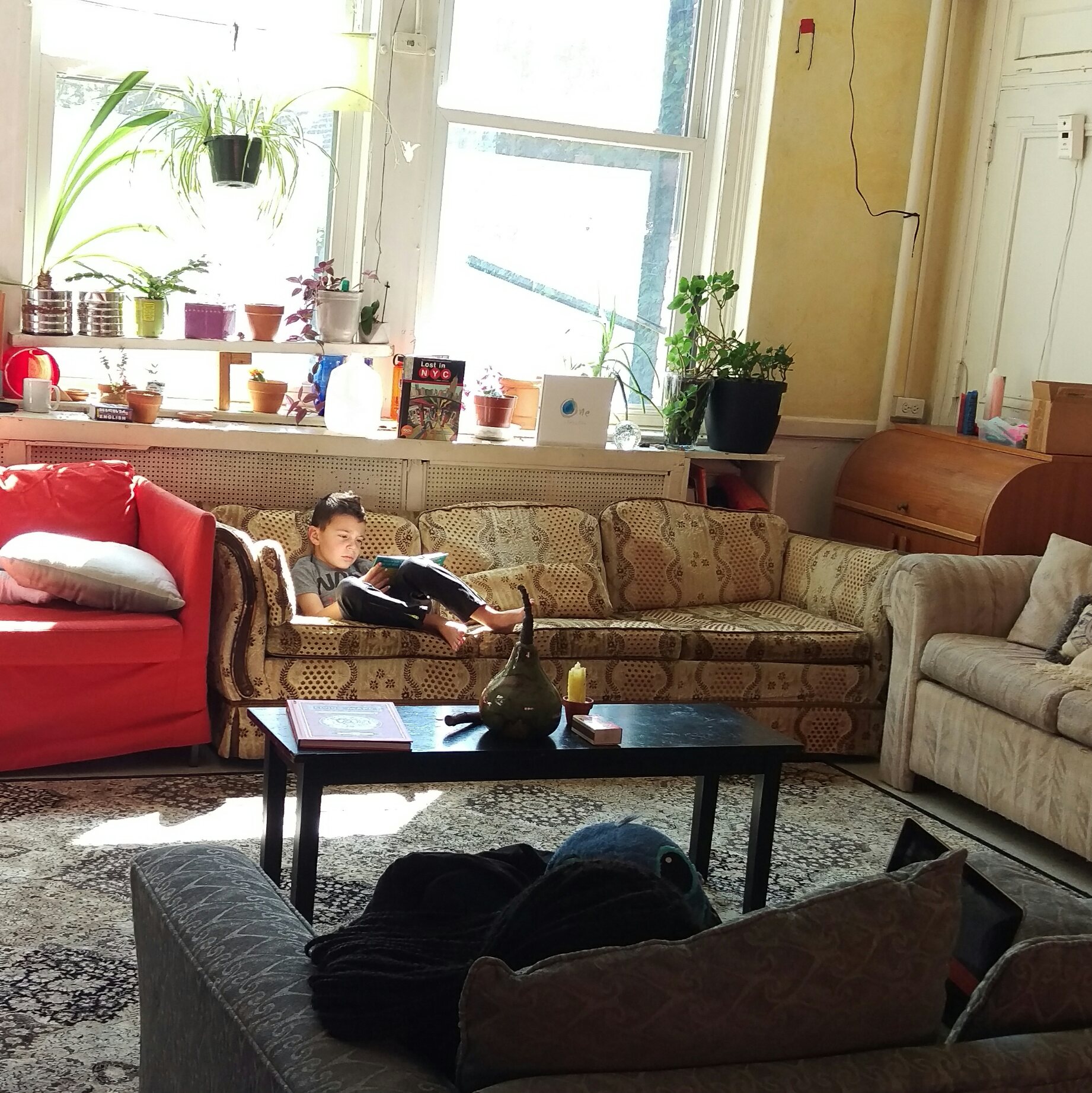
When it was time for today’s first reading, we selected “Hollow” by Mia Mingus. We gathered on a couch, I asked a kid to hold my livestream-recording phone, and we began.
It’s been so long since I’ve done a read-aloud. I did one recorded one by myself over the summer (not live or public) and read a comic book to a kid last spring (not recorded at all). This was surreal. I had expected that my energy would flag, that my throat would dry out, that the world would noisily continue around us. But I’d underestimated the ways in which reading something other than a picture book to a live, virtual audience would change the experience.
The kid holding the phone was holding it where I could see notifications popping up, but I couldn’t read or respond to them while focusing on the text. I caught myself worrying about not having had the foresight to discuss this with her — was it distracting her and changing her experience? Were the internet strangers behaving, there on my device in the hand of this young person? Were they making requests — that I slow down or speed up or or or — and putting her in a position of wondering whether to listen to the story or interrupt me to share their comments?
Was her arm tired? At one point, the other adult listening got up and retrieved pillows for her back and mine. I was so grateful! And aware that I couldn’t figure out how to shift so that the kid holding the phone could rest her arm. I mostly trusted she’d be confident enough to do something about it if she started hurting, but my experience of young femmes being conditioned to feel a need to tolerate pain for others’ comfort had me worrying.
Usually I would stop what I was doing to share my worry and check in. Just like I’d pause to tell a facilitator coming into the room where I’d seen the item they are clearly searching for, to thank the other adult for the caring pillow-retrieval and to ask if she’s okay when she trips on the carpet, and to gently check kids bring loud conversations into where we’re holding a focused offering. But. We were recording my voice and the pages of the book. Our virtual audience couldn’t see what was happening beyond the screen and all of us participating were falling into the flow of the story. So when to interrupt us? I only paused twice — for gratitude and to let some littles who burst into the room know we would be done with our quiet time shortly.
And finally, what am I doing with this story? Like…the author does work on accessibility and disability justice, so I feel pretty sure that offering free, audio versions to make it easier for folks to join us is in the spirit of her work. I wanted to go slower, so the listening would be easier on more folks, but I also wanted to respect the time constraints of those with me. Aside from that tension, going slower would me more clearly pronouncing the names of all the characters…and while the diversity of the kinds of names in the story was something I noticed and treasured reading it silently to myself, it also sparked some self-consciousness as I spoke those names aloud. Was I saying them as the author imagined, as her characters would want them said? Was my delivery doing the story I’d been entrusted with justice? And I had forgotten the accounts of violence, some of the swearing…so I hadn’t posted a content warning or checked too closely to see who was in the room. I just sat down to read.
People did tune in for the reading, and I’ve been asked for recordings so I anticipate positive feedback on this experiment. But what an unexpectedly learning-full experience! I’ll be better prepared for the next one…Already have the story picked out 🙂
 abbyoulton.com
Leave a comment