There’s a 12 year old at the Agile Learning Center who has been updating me on her growing interest in elementary education. So when I got an invitation from Play Futures to get a recording of their webinar on “Why Play Matters,” I asked the kid if she’d be interested in watching it with me.
So on October 9th (2019) we tucked into the Makerspace with our notebooks and laptops to watch the recording. The webinar featured Caroline Essame, based in Singapore and speaking from her practice in art therapy, occupational therapy, and education for folks with disabilities. It also featured Linda Smith, based in South Africa and coming from a constructivist and research background in her work with parents and teachers. Alicja Peszkowska moderated.
Opening Remarks
“Play is an imporant way for children to gain essential knowledge.”
“We know children and naturally curious and motivated…” (Caroline)
[Paraphrased] Teacher’s job is to provide a safe, happy environment, to offer opportunities and time, and also to accompany kids as they solve problems and come to understand their self/world/interactions…Kids need agency, ownership, and control over their play to deepen their learning.
Characteristics of Play (c/o LEGO Foundation)
I’d learned while at the LEGO conference a few years ago that their foundation has some really interesting research supporting the idea that play is vital to our development and learning as humans. The white paper is online here.
In the webinar, the “Characteristics of Play” articulated through that research were listed as:
- meaningful sense-making
- joyful
- actively engaging – draws on skills
- Iterative – practice, discovery, motivating
- socially interactive
Ignite the Spark of Playfulness
Linda shared about Cambridge’s Pedals project (which the student watching with me quickly looked up in another tab…you can too with this link), Harvard’s Project Zero, and a 2 year project called “Pedagogy of Play” that started with research at 3 schools in South Africa.
The focus was on expressions of ownership, creativity, and enjoyment in learning environments, as well as manifestations of “Ubuntu,” a concept common in South Africa. Ubuntu is a reminder of interconnectedness, a philosophy that says ‘a person is only a person through other people,’ which leads to the idea that ‘learning is never really done in isolation.’
The project that followed, “Ignite the Spark of Playfulness,” initially gathered 8 experts in South Africa. Their goal was to promote playfulness and address challenges. In their observations, the main challenges that had been identified as priorities were parents’ and teachers’ perceptions. The gathering was an exploration, where the experts brainstormed and ultimately decided to create a shareable graphic.
So how to convince adults that play matters?
They considered what adults value, what they want for themselves and their children. They ended up looking at the “21st Century Skills” that the World Economic Forum published in their New Vision for Education in 2015.
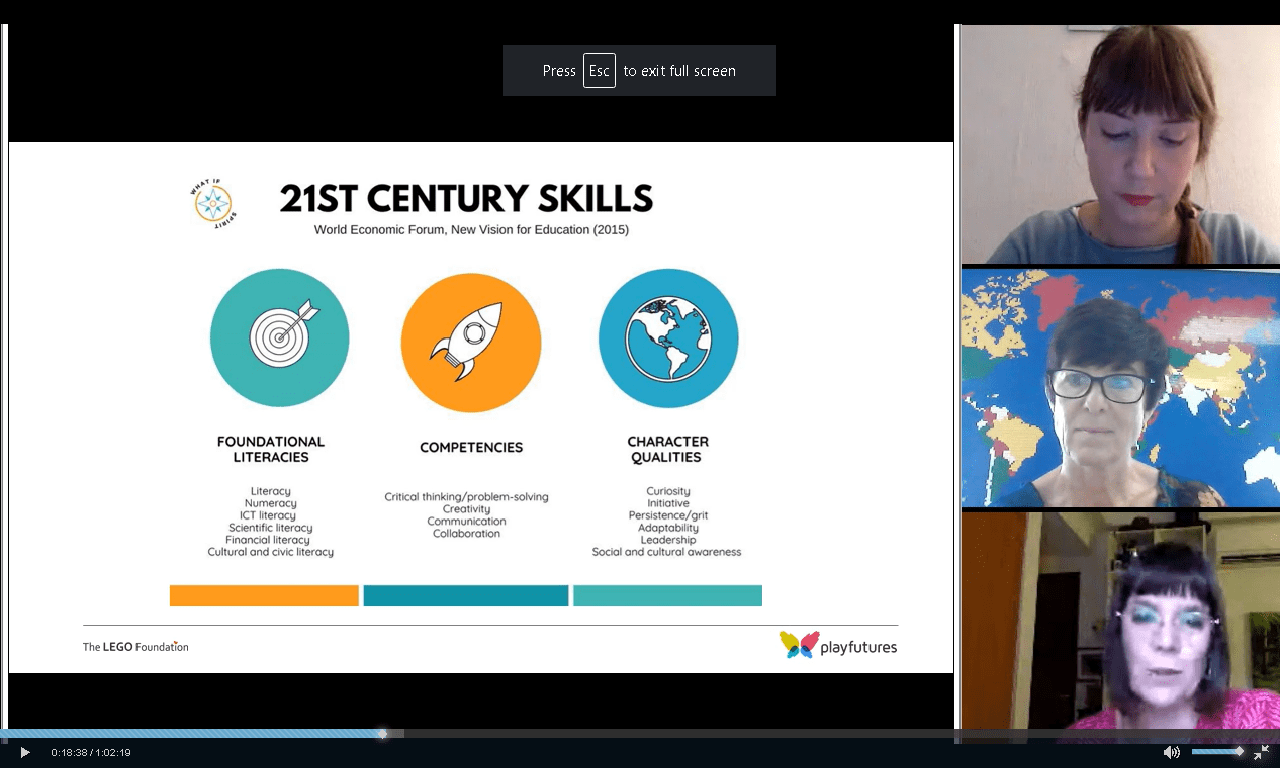
They then worked on translating this research into accessible terms for the adults they were looking to inspire change in. They wanted to take the abstract categories of “foundational literacies, competencies, and character qualities,” pull out 9 specific skills nested in those categories, illustrate how play develops each of those skills, and then turn the whole thing into an engaging poster. Ultimately this meant they used child-centered “I statements” and a playful image for each skill.
(We paused the video here to copy the image in our notes and discuss the project-process we were listening to an account of. We discussed the roles of educators and education researchers, as well as possible dynamics between folks from the two worlds.)
After the poster was created, Linda and her colleagues began using them and giving them out in workshops. The goals for her in these workshops, and generally in her play advocacy in South Africa, she described as raising awareness, changing mindsets, and building on the existing global movement. She described that her local context was work with adult “caregivers,” which is the title given to anyone who has contact with a child…to be inclusive as possible and so reach adults influencing kids beyond those who would attend “parent”or “teacher” workshops. In their training space, she found that attendees expressed appreciation of having a tangible take-away (the poster) from the workshops. She also described how they found it most impactful to give out the poster at the beginning of the workshop, to help guide the adults’ relationships to and reflections on their own play as they moved through different activities together. She mentioned that having the cultural investment in ubuntu was helpful. Meanwhile, getting adults over their fear of failure or looking foolish, so they would actually engage in play, was a challenge.
Developmental Play
Caroline shared about using the poster in the context of a conference in Singapore. The conference was on “Developmental Play” and play for kids considered to be at-risk due to disability or to poverty. This context, as in South Africa, was a training for adults in which the poster was received as a useful tool when offered in a “show, don’t tell” styled workshop.
Caroline also shared her Developmental Play framework:

+ a note that community is key!
It was really refreshing and powerful to hear her close with: “Babies start playing to explore, to learn, before birth…If they aren’t playing, [we need to be asking] why?”
Question and Answer Session
To conclude the webinar, the moderator took questions from those present. They’d recorded the offering at 6 am our time, so we weren’t there live to submit questions. We were as curious to hear what people would ask as we were to discover what we could learn from the answers.
The first question was one I’m familiar with from years in alternative education: How do you convince folks to let kids play, to protect and celebrate play as valuable and vital?
The answers were to help them [the doubting adults] not be so scared and to help them learn to see how learning happens through play. An insight was that they will have to experience this, so it’s powerful to get them playing and involved. Practice > Theory! And embodiment is a key part of practice! This can be challenging because adults have often forgotten how to play and how they learned from playing. They also are often scared of shame and looking foolish, so a facilitator has to create a safe space or they won’t let themselves play. They also often want to know what’s happening in their minds and bodies, so be prepared to have those reflection conversations with them after they play and laugh (one possibility is to have them take stress tests both before and after they play!)
The second question was how can we train adults to help kids play?
(I bit my tongue on some feelings about the assumption that adults need to or should “help” kids play.) It was pointed out that adults are often busy and skeptical, so the first challenge is to get their attention. Then the second challenge is shifting their perceptions. One possibility is to have them gather for a playgroup, with kids, where they play together and then have time for guided reflection on the experience.
The third question was about how child-directed free play compares to adult-directed play in a classroom.
It was asserted that free play is super powerful and full of learning potential. Caroline had a bunch of great quotes here, like, “Children know what they need to do. My job as a clinician is to help them structure and reflect back and make sure they’re kept safe. I’ve never seen anything more powerful…Play turns on a button, when they’re allowed to play at the level they need to play.” She also advised that we should support adults who stop children from playing in coming to understand the value of their free play.
The fourth question was about hospital applications of this understanding of the value of play.
The response was that neither panelist had much experience in hospital contexts to speak to. They did muse on “creativity work” programs offering theater and music to adults. They also concluded that letting children play even/especially in hospital settings could offer them a sense of normalcy and control, which could be very helpful.
Question five was about their experiences working with early-childhood educators.
Linda explained that in South Africa, they work with educators called “practitioners,” who aren’t certified. These are adults who open their homes as safe spaces for children, and while they’re often open to changing their relationship to play, they also are often feeling some pressure and toxic stress creeping in from other environments.
Formal teachers struggle with a tendency to relate to the research they’re presented on play more as an add on to their curriculum than as the invitation to a new methodology that it actually is. For adults, the assumptions they carry as they shift roles from “teacher” to “facilitator” can be huge obstacles for them. Most adults aren’t used to operating from the basic assumptions that children have their own agency and that play is valuable. Figuring out how to get adults to the place where they can trust the process and the learning in the apparent chaos can be tricky. And that’s aside from the practical questions of how to help those in traditional teaching positions navigate the pressure and demands of imposed curricula while advocating for more play, or how to change parent expectations to allow for more mess.
Question 6 was about guiding reflection on play: does an adult setting and leading a reflection session support meta-cognition or steal joy?
Caroline asked, “Who needs to know why the child played?” The answer: “the adults.” Then she talked about understanding play as meaning-making, which leads to the ability to trust that children make meaning as they’re ready, that they have done and are doing it. “Why do we need to know?” she asked, “Because we don’t believe it?”
Question 7 was about whether there is tension between free play and “play” as a tool to coerce the direction of learning.
This was somewhat of a re-casting of question 3 and time was running out, so the answer was briefly that there is tension but it isn’t necessary. Since play is learning, we have the option to trust the process, let kids play and explore instead of trying to force them to learn what we want on our time, and be free of the dilemma causing this tension in the first place.
More info:
Caroline’s websites are developmental-play.com and spreaker.com/create2learn
Linda’s website is caredfored.co.za
PEDAL’s website is https://www.pedalhub.org.uk/
LEGO’s research is at https://www.legofoundation.com/en/what-we-do/research-centre/
 abbyoulton.com
Leave a comment