This post shares a long draft of an essay which later became an article published in the Cutter business journal’s 2019 special issue on applications of Agile. I’d been asked to share about the Change-Up process, and I’m grateful for folks across the network sending stories so I could include use cases from a variety of contexts.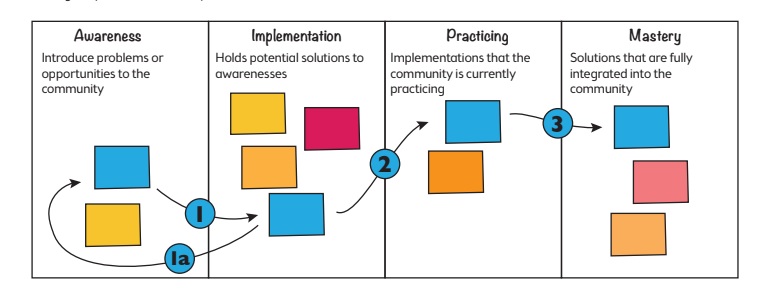
As the changing world inspired software developers to create more adaptive ways of working, innovators in other fields took notice. Following the popularization of Agile in tech spheres, educators who knew about it began experimenting with creating “agile classrooms,” typically seeking to increase student engagement and collaboration in otherwise conventional environments. For those in a small East Harlem start-up, though, commitment to putting individuals and interactions over processes and tools, as well as other Agile principles, meant reconsidering nearly everything education in the United States is commonly thought to be.
In 2012, a group of parents and facilitators at a democratic free school, a school that kids and staff run together using democratic processes, got word that the director and staff were resigning. Rather than let the school fold, they worked over the next year to keep it open while transforming it into something new. In the fall of 2013, they reopened as the Agile Learning Center, or ALC. The ALC application of Agile is informed by a definition of education that includes all the learning people do as they live and interact with the world. From this understanding, the role of schools and learning centers shifts drastically away from coercion, testing, and standardization to accompanying and supporting young people steering their own journeys as much as possible while practicing responsible participation in community. Accordingly, ALC renounces grades, age-segregation, and mandatory classes. Staff are present for safety and support, but their job is not to manage or direct kids’ activities. Mixed-age groups of students co-design each week’s schedule, track their individual activities, handle most conflict mediation, and hold regular discussions of the running of the school.
The design of democratic free schools prioritizes learners discerning and developing their own interests and talents as much as possible while practicing collaborating to shape their larger community. Since part of their mission is to raise kids practiced at navigating the governments of democratic nation states, the formal structures such schools use for designing and managing their community mimic those of the state. In the same way such governments can become inflexible and bogged down by bureaucracy, democratic free schools can sometimes find their kids end up spending long hours in meetings, developing rulebooks that grow thicker with each generation. With new models available to them and the world changing as fast as ever, the original ALC community was ready for a change. They made clear that they still valued kids having both the freedom to personalize their studies and the power to change their environments, regardless of their ages. Reflecting on what hadn’t worked for them as the free school, they realized they were looking for ways to support student self-organization, increase intentionality, streamline meetings, and encourage continual adaptation to changes both within and around the community. One of the parents who had been called in to organize brought experience with Agile from his work in tech; he suggested it had been designed to facilitate the kinds of changes that the group was hoping for. When he offered to direct the school for a year and guide the transition, the others agreed the idea had potential and decided to give it a try.
They replaced Robert’s Rules of Order and Judiciary Committee eagerly as software developers replaced Waterfall. They hung Kanbans, experimented with Scrum for 7-year-olds, and started a process of iterating in daily cycles and weekly sprints. Some of the changes caught on quickly, while some failed or went through several rounds of fine-tuning. In the fall of 2013, they reopened officially as the Agile Learning Center of New York, or ALC-NYC. Since then, that flagship school has quadrupled in size and navigated some major changes. Enrollment, finances, and staffing all fluctuated in the first few years. Nancy Tilton, who ran a school in Charlotte, North Carolina, and Alexander Aldorando, who was living in San Juan, Puerto Rico, both were inspired to start local ALCs in 2014. Collaborating with the ALC-NYC team, a number of smaller homeschool co-ops, and unschooling families, they seeded the growth of what is now a global network of more than 50 ALC projects, all operating independently while collaborating and supporting each other.
While change remains constant, 6 years into their experiment the ALC-NYC community notices the kinds of flows and rhythms they were hoping for have emerged. Mixed-age group of students work with staff to co-design each week’s schedule, track their individual activities, and tend the daily running of the school. Daily school-wide stand-up meetings were transformed into video-game inspired huddles of smaller groups. The conflict mediation process has been developed into one almost entirely managed by students and with a decidedly restorative rather than punitive approach. The whiteboard that held Scrum notes now tracks who consents to prank games and who has committed to attend different group activities each day. The tools and processes have changed, by and for the people and interactions they were implemented to serve. As the network of ALC programs grows, such changes and observations of their impact get translated and shared with young people across continents. Some ideas get adopted by many ALCs, such as the wording for basic community agreements. Some stay where they’re from, like the agreements the ALC in Veracruz, Mexico has for protecting student lunches from a beloved but sneaky campus dog. Regardless, the insights from shared experiences are available to those across the network, to reference, copy, or adapt when they want. The process for reviewing and making such changes differs slightly across ALCs, but the ideas about how the community relates to change and each other that underlie all variations came straight from Agile. What’s more, as other self-directed education spaces open, these orientations have proven to be among the most distinctive and useful elements of ALCs.
When adapting away from the elaborately structured meetings and multi-page rule books of their past, the early ALC community knew they wanted more efficiency and more flexible ways for the community to manage itself. They introduced daily small-group meetings, where individuals start the morning sharing their intentions for the day then circle back to reflect on their progress before heading home. They introduced a collaborative scheduling meeting at the start of each week, with whiteboards explicitly inviting updates as community plans change, and they established a time at the end of the week for recording sharable reflections. Perhaps most notably among both “Agile classrooms” and self-directed education projects, they used the iterative, reflective, and adaptive Agile approach to project management in both redesigning the form and function of the all-school meeting. While the influence of Agile principles can be felt in a variety of ways at ALCs, it is especially apparent in this meeting and the larger course-adjusting process that the meeting helps facilitate.
Instead of a weekly governance meeting to vote on rules, they initiated a weekly check-in meeting to review progress on their ongoing group project: evolving the community’s culture. Through each week, kids and staff note trends, changes, and problems that they’ve become aware of and want to discuss, posting their notes in the first column of an adapted Kanban known as the Community Mastery Board. At the meeting, those present turn those awareness notes into agenda items. They brainstorm adjustments to the space or to their agreements that could address awarenesses, strategies they maybe would not want to write into a rule book without more discussion but that they can agree to test until the next week’s meeting. The next column on the Community Mastery Board holds notes of what changes are currently being tested. Each week, the community reviews these notes and decides how to proceed. Changes that are not working get revised, or replaced. Changes that the community wants to keep get moved to the next column on the board, which reflects what the community is currently practicing. Notes in that column help the community members stay mindful of what they agreed to practice. If eventually the community has practiced something so well that it becomes second nature and an unspoken part of the culture, they may opt to move the relevant note to a column on their board that’s been designated for mastered practices. Alternatively, they may pull the note and put it back with the awarenesses, to begin a new cycle of reflection around it.
When it works well, the process is light, supporting intentional iterations and collaboration in shaping a living culture, contrasted to the long and litigious meetings to bulk up rule books that earlier self-directed education spaces often included. Checking-in on and playing with the mutability of the school culture empowers young people to notice and actively direct the impact of their choices. It also keeps the community’s relationship to protocols and problem-solving one of creative response rather than controlling prescription. At its most basic, the meeting, usually called Change-Up, serves as an opportunity to reflect on the current situation and emerging trends. Topics can be as concrete as where cleaning supplies are being stored and as abstract as what it looks like to treat people with respect. By taking time to articulate and reflect on how the community currently functions, participants bring awareness to the power of their choices and the power they have to change the experience of the space for everyone. Mel Compo, a facilitator from ALC-NYC, shares how a game they introduced took on a life of its own and got brought to a Change-Up meeting:
“I didn’t mean to start Fives. It was an old habit that surfaced in my first year as a facilitator, when I was less careful about my language. Fives was a game, of sorts, that I played with my friends in high school: if you say ‘fives’ as you’re getting up from your seat, it gives you five minutes to come back to it, even if someone else sits there in the meantime. Useful for getting something or going to the bathroom, especially among adolescents still learning the difference between playful teasing and actively antagonizing each other.
So there I was, at ALC, when I unthinkingly stood up from my chair and said ‘Fives!’ The kids around me picked it up immediately after asking, ‘What’s Fives?’ Our culture is viral, and by the end of that week Fives was everywhere. I felt a little weird that I’d introduced it so thoughtlessly, but I also felt like it was harmless enough.
“Fives went on, unofficially, for several weeks, shifting and changing. Kids started calling fives on every chair in the game room, to try and limit how people could access the computers, or on the very popular swing in the lobby. Finally, a kid brought it to Change-up, because they wanted to shift the developing pattern of using Fives to be unfair and unkind to each other. We talked about it, and decided to make it an official school agreement. You could only call fives on one seat at a time (the swing is not a seat); use Fives if you get up, and no one can take your seat. This worked pretty well. Your seat would probably get stolen if you didn’t call Fives, but generally things flowed.
“That school year ended and we cleared all our agreements – including Fives – off the Community Mastery Board, as we usually do to reset. The next year came and went, and, while some people continued to use Fives, the novelty had faded. It didn’t get brought back to Change-Up and was not an official agreement. It was useful and, for the most part, we did it without much thought or conflict.
“Then, this year began. Fives persisted but, unlike last year, it didn’t go smoothly. The issue was not overuse of Fives, like it had been at first. The problem now was that some people decided they didn’t respect Fives – just enough people to tip the scale. It’s one of those systems that gets thrown out of whack pretty easily by someone saying ‘I don’t do fives.’ So someone brought it to Change-up again, back in November. We discussed it for a while, but ultimately we decided that a few people abstaining wasn’t a big enough problem to merit bringing back an official agreement. We decided that we’d discuss it again if seat-sharing got really contentious.
“A few months went by, and Fives came to Change-up again. The resulting discussion floored me. The awareness was the same: some people were abstaining, and that messes up the system. I felt like reinstituting Fives as an agreement was the obvious solution, but our culture-minded kids felt differently. Making an agreement, they argued, would lead to an increase of contentiousness, not to a more peaceful and respectful environment. If the intention of Fives is to let people have space to tend their bodies or get something they need and still come back to where they were, then we should just decide we care about letting people do that. They speculated that making a Fives agreement would lead to people trying to use the letter of the law to get around the spirit of it. They didn’t want to make more agreements; they wanted us to take better care of each other. So that’s what we decided to practice.
“I love how the iterative Change-up process centers ways take care of each other, as we change and our needs change. And I feel especially humbled and inspired when I reflect on the resolution our community came to, instead of codifying the easy, possessive practice that I thoughtlessly introduced.”
Clearly, explicitly discussing which community values are being bolstered or undermined by current norms helps the group decide how to move forward, letting them recognize more easily when there is a pattern to the awarenesses they’re considering. Realizing this, several communities used the meeting process to propose and implement modified versions of the Community Mastery Board. On the updated boards, a column coupled with the one for awarenesses asks those posting agenda items to name the need or value inspiring them to bring their topic to the group’s attention. This column helps the group know, for example, whether someone’s awareness about how food is stored has more to do with their desire to limit mess, deter mice, or improve accessibility.
Even when the values under an awareness are clear, it may still be discussed over a span of weeks because the community needs to workshop different solutions. Since the process is collaborative and it is clear that changes the group tests do not need to be kept, students have space to experiment as they figure out how to address complex situations. There are cases where a practice the community is testing needs to be adjusted, there are cases where the kids are deciding whether something is an individual responsibility or a group responsibility, and there are cases where both situations play out at once. Jordan Quandt, a student from Free to Learn in California, shares how his community negotiated wanting to play videogames, support a friend, and attend scheduled activities:
“One day, one of my friends had a new awareness at Change-Up, and it surprised all of us. We did not see it coming! But, I share it because it KEEPS coming up and we are still using a related agreement today. The awareness was that our friend needed our whole community to have less screen time! He was worried that his mom wouldn’t let him attend Free to Learn anymore if there were no screen-time limits. All of us gamers decided to try doing 3 hours off screens per day.
“That was fine for me, but some other students weren’t happy about it. Since I was fine with it, I stopped attending change-up when they talked about it. But one day in the second semester, I attended because there was a different awareness that I wanted to talk about. Since I was already in the meeting, I decided to stay for the screen-time conversation.
“During this meeting I suggested breaking up the three hours on three different post-it notes and then each morning, when we set our day, we would able to separate screen-time hours and choose when the screen-times happened. This way we didn’t miss other activities that we wanted to participate in. This was actually good for the whole community; we liked it and we kept it!
“Every new school year we start the year fresh and clear our Culture Board. This year, the topic of screen limits didn’t come up for a while. But, when it did, we wanted to think of another solution. We decided this year that it would be no screens for our scrum and meetings, plus no screens until 12. Everyone really likes how it feels, and we haven’t had to change it at all.
“Even though sometimes, like last year, it takes lots of adjustments and weeks or months of trying new ideas, whenever we use the Community Mastery Board we always come up with some practice that everyone is ok with. It helps us solve all kinds of problems. We even use one at home now!”
In Jordan’s community, the kids decided giving up some personal freedom to help their friend best served them all. In other situations, the community finds ways to rally behind a kid asking everyone to make a change without all agreeing to make the proposed change. Crystal Farmer, a facilitator from Gastonia Freedom School in Georgia, shares about a time the kids tried to better support a friend’s enthusiasm for time management. Upon reflection, they decided it would be better to get their friend the support she was asking for without mandating the same tool for the whole community:
“Midway through our fall semester, one student was eager to provide structure to her day by having everyone adopt a detailed schedule. We created the schedule, but at the next Change-Up meeting, I asked what everyone thought about it, noting that the student who initiated it was interested in following it, but only when the others played along. It turned out the others weren’t so interested in it. We’re an ALC focused on children with disabilities, so our kids have a lot of experience not having control of their lives. Our Change-Up meetings are an opportunity to help them use the skills they need to live independently as adults. In this case, we had a great discussion about intentions vs. outcomes. We also decided it was okay to make plans then change them when we realize they aren’t working. The schedule went away, but our kids gained confidence in saying what worked for them and navigating disagreements.”
Even when a change the community is testing feels helpful, clearly addresses the need that prompted its invention, and has community buy-in, it may still get revised as the actual abilities of the people involved become clear. In ALCs in both Canada and Mexico, facilitators have stories about their communities’ adventures balancing environmental concerns with realistic expectations for those in age-mixed communities. Marc-Alexandre Prud’homme, a facilitator from Mont-Libre in Québec, shares about an instance when students decided that managing everyone’s groceries was just too big a task. Even so, they wanted to do something to keep the awareness of what they’d learned about food systems alive among them:
“During one of our current-event workshops, we looked at Monsanto and GMOs. On many occasions during these workshops, we also try to look at something that we can do to help in a given situation. For instance, we have signed various petitions or made videos to raise awareness about certain problems. For our workshop on Monsanto, I did not have the chance to prepare anything of that nature. However, at Change-Up, one of our teens suggested that we ban Monsanto from the center. Realizing that this was going to be a difficult task for our whole group, we settled on an agreement among us that if you eat something Monsanto might have helped produce you have to do a chicken dance for 20 seconds. Given that not eating anything that Monsanto might have touched is a difficult task, on most days, we dance together as a large group. This way, the first day we did it, those who did not attend the workshop or the Change-Up asked what we were doing and why. This gave us the opportunity to have a great conversation.”
Maria Abigail Gonzales, a facilitator from Educambiando in Veracruz, shares about a time the students tested a variety of simple and complex solutions to a litter problem:
“The awareness was that we were generating lots of trash. The proposed solution was to make Brick-Bottles: plastic bottles filled with single-use plastic waste then used for building. When we reviewed our attempt to test this solution, we realized that not everyone was following through and it was hard to hold everyone accountable. So we decided to revisit the awareness and try something else.
“The second proposal was to form a committee specifically of the people who went to buy snacks from the store. They organized into different roles: an adult who would accompany them, those who registered participants of the trip, those who listed who bought what so they could later identify who wrappers belonged to, etc. After a trial period, where the committee held several meetings, experienced rotating leadership, and still kept finding candy wrappers and plastic bottles,.they decided it was too much. We went back to the original awareness again.
“Our community became aware that we really didn’t want a polluted space. We had other proposed solutions at Check-In, but the one that received the most votes was that Educambiando become a waste-free zone. People now take their containers when going to the store, empty what they buy there into their containers, and leave their trash in the bins at the store. It took some practice, but this solution seems to be working. The problem of generating trash has considerably decreased.”
Knowing that sometimes what a group is capable of only becomes clear as they test themselves, students occasionally will establish steps and conditions for solutions they want to test. Iphigene Murphy, a student from ALC-NYC, writes about an instance of this when a younger student in her community was feeling lonely and proposed getting a pet:
“On January 11th, Matilda proposed in Change-Up that we should get a hamster for the school. We had a lot of questions, like, ‘Where will it go for breaks?’ ‘Are we too loud as a community to have such a delicate animal?’ ‘Do we know how to handle a hamster? What happens if we drop it?’ ‘Who’s going to clean out the cage?’ and ‘What will happen if it dies?’ We also recognized that a pet could teach us a great deal about responsibility and have an overall good impact on the school.
“At that Change -Up, we decided to have a trial week to see if we could take care of this hamster. One of our facilitators, Ryan, called a pet store to ask if we could return the hamster in a week if we decided it wasn’t a good fit. Meanwhile, people did a bunch of research on how to properly care for a hamster.
“The pet store said yes, so we adopted the hamster and set up their home. When they were rolling around in their ball, lots of people who were against a school hamster started to come around.and lots of people who were against a school hamster were starting to come around.
“The following week at Change-Up, we decided that it had been going excellent, we’d been good about our volume, and we had been great handling the hamster. We had made a team of people to alternate cleaning the hamster cage, and we had learned a lot! So we decided to keep the hamster and name them Cookie!”
Through Change-Up meetings, those in ALCs are able to consistently adjust how their communities function in response to the changing needs, values, and abilities of their members. What’s practiced at the local level has also been adapted at regional and global levels as the network of ALCs has grown. Sharing a foundation in practices of collaborative experimentation, reflection, and adaptation has allowed those guiding the network’s growth to engage as they would in any one project. Early awarenesses included needs for translations and audio resources, support calls that considered different time zones, alignment of our practices with our principles among cohorts of adults, and work to keep development informed by what facilitators need even when they’re too busy with kids to join most meetings. More recent awarenesses include that a set price membership fee set in USD isn’t accessible for those in countries with “weaker” currencies, that developing research across ALCs would help local organizers looking to change national policy in countries where non-state education is highly restricted or unavailable, and that the tech tools facilitators have been using could use an upgrade. The clear principles and highly adaptable practices of the first ALCs, including explicit dedication to open-source generosity–has allowed communities all over the world to create spaces that are recognizably ALCs but that work for their contexts. Exchanges of facilitators and kids over the past two years have consistently been followed by reflections that each ALC feels both distinct and familiar. Part of the original goal was to scale without losing connection to the mission of creating and supporting self-organizing learning environments. While the experiment is still very young, its growth and accomplishments so far seem promising. Back at ALC-NYC, the facilitators expect the changes and challenges to continue. They feel ready and curious, excited for the learning the rest of their first decade will bring.
 abbyoulton.com
Leave a comment